Plan Your Best Trip Ever!
"Edmonton"

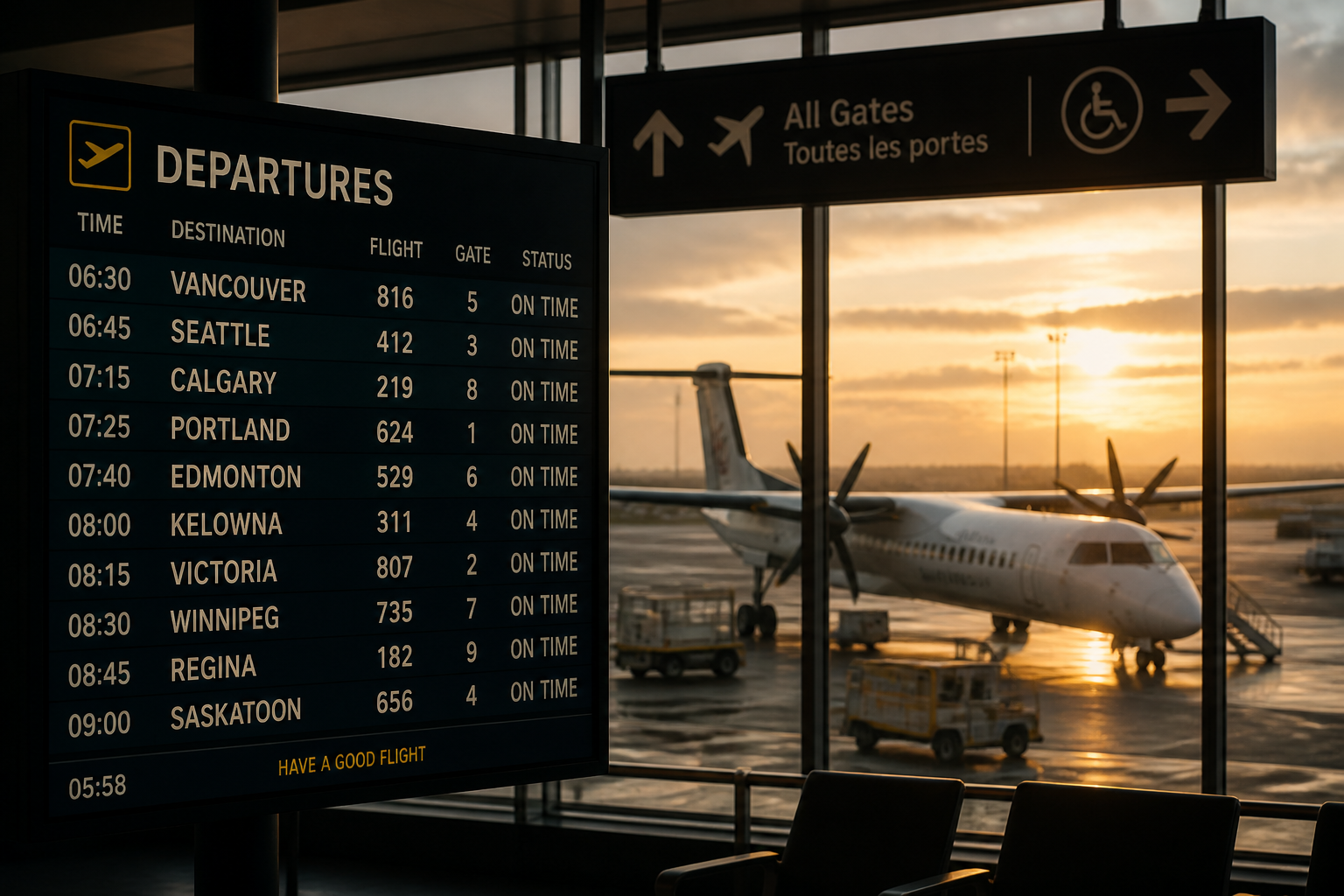
One ticket, one airline, two hops each way. More steps, but every step is a step I can plan for.
I could have chased a direct flight into Seattle. On paper that's fewer connections, less walking, less time in airports. In practice, a single-ticket routing means if something goes sideways — a delay, a missed connection, a gate change — the airline owns the whole problem, not me. One booking reference, one accountability chain, no re-checking bags or re-clearing security mid-journey because two carriers are pointing fingers at each other.
For a disabled body, predictable beats easy. I'll take a routing with more steps if every step is one I can see coming and budget for. A direct flight that saves ninety minutes but puts me on a different airline's problem if it goes wrong is not a savings — it's a liability I can't absorb.
Outbound: I stayed at a hotel the night before. Early departure means the body needs runway — not just time to get to the airport, but time to wake up, move, eat, and arrive without already being spent before the first security line. That hotel night was the single best accessibility decision of the whole trip.
Bags were checked before security even opened. That bought time and took weight off my body early — no hauling a bag through lines I didn't need to.
Then came the walk to the gate. Edmonton's moving sidewalks don't start until around Gate 79, and they run up through the 90s — but they begin basically at our gate, not before it. So you walk the whole distance on foot, and by the time the sidewalks appear, you're already there. If you're a walker who's fine on distance, it's annoying. If you're running on fumes or your mobility is marginal, it's a real cost. Plan for it.
At the gate, the scanner glitched and didn't recognize me. They flipped me to manual boarding — no drama, just a few extra minutes and a human instead of a machine. Here's the thing most people don't know: a lot of airports will let you opt out of the auto-gate scanner entirely if you ask. If your body or your anxiety can't handle random scanner drama, build in five extra minutes and ask for manual boarding up front. It's not a special accommodation, it's just a different line.
Boarding was via jet bridge — no stairs, no tarmac walk, no bus. The flight itself was uneventful in the good way. Nothing to flag. Seat was fine, noise was manageable, crew did their job, I did mine. Sometimes boring is the accessibility win.
Return: Coming back through Edmonton, we landed at the gate closest to the exit. After a full trip with end-of-trip fatigue stacked on top, that was a genuine gift — no long slog to baggage, no moving sidewalk teasing. Straight off, straight out.
The contrast between legs is worth naming: outbound, the walk to the gate is a slog because the moving sidewalks only start basically at our gate. Return, our gate is right by the exit and my body was very into that. Same airport, completely different body cost, depending on which gate you get.
Deplaning in Vancouver was smooth. No stairs, no friction, just a normal walk off the plane into the terminal.
Pre-clearance for the US was uneventful. Nothing was flagged, nothing was pulled, we just continued on. If you're travelling with meds or medical equipment, Vancouver's pre-clearance didn't create any issues on this trip — but that's always subject to the officer you get and the day you're having. Have your paperwork organized and accessible, not buried.
The walks through Vancouver are long but doable. There are shuttle options if your body needs them — just don't assume they run on your schedule or that you'll find one when you need it. Know they exist, know they're inconsistent, and plan your walking budget accordingly.
The hop from Vancouver to Seattle was on a Bombardier Q400 turboprop, boarded via jet bridge. Smaller plane, shorter flight, no issues on the way out. The important thing to know is what happens when you land — see Seattle.
Arrival: This is where the routing needs the most flagging.
We landed and deplaned via the Q400's built-in stairs, straight onto the tarmac, then up to a jet bridge. The Q400 carries its own stairs on the airframe, so when it parks at a stand, the door opens onto the tarmac — that's just how the plane works. If you can't safely do stairs, you need to know that this specific leg — Vancouver to Seattle on a Q400 — involves a stair descent without prior warning.
A ramp was available at Seattle — it just wasn't used, because nobody on this particular flight needed it. I know from my own ground-agent days how this piece works: if the airline knows in advance that someone needs the ramp, they'll put it in place instead of the stairs. But either way, you're still deplaning onto the tarmac — the ramp swaps out the stairs, not the tarmac part.
The heads-up came on arrival — an announcement that we'd be deplaning onto the tarmac. But there was no indication of that prior to departure: nothing at booking, nothing when we checked in, nothing at the gate. You find out on the ground, not before you fly. If that's a hard limit for your body, this is the piece you need to plan around before you fly.
Baggage was its own adventure. We were told which carousel to go to, made it there fine, and then learned that the ground crew had been regularly putting bags on the wrong belts. So you stand there in limbo, watching a carousel that's supposed to be yours, not knowing if your bag is actually coming or if it's been routed two belts over. Ours eventually came out near where we were — but the uncertainty is the cost. If you're already running on empty, that standing-and-waiting-without-knowing is a real drain.
Getting from baggage to transit out of the airport was a long, noisy walk, and the shuttle that's supposed to help does run — but its posted signs can't be trusted. The schedules were posted, but the signs said closed when the shuttle should have been open — and the shuttle was running. If you trust the sign and keep walking, you can nearly get run over by the shuttle coming back, which almost happened to us. It was later in the day, so it should have been open long before we got there; my best guess is the sign just hadn't flipped yet on that end. Either way: don't trust a closed sign over your own eyes. Look before you walk. Budget real spoons for this stretch. It's doable on foot, but it's the part of the day where a tired body hits a wall if it doesn't know the wall is coming.
Lounges aren't luxury for disabled bodies. They're a place to sit down and stop processing for twenty minutes — quiet, seats that aren't gate-area benches, and a buffer between you and the next loud, crowded stretch.
I deliberately skipped the Edmonton lounge to afford lounge access in Vancouver later in the day. That was a body-budget calculation: Edmonton was early, I was fresh, and the airport was quiet enough to handle. By the time I hit Vancouver and especially Seattle, I was deeper into the day and deeper into my body's limits. Spending the lounge money where the fatigue was thickest made more sense than spending it where I still had runway.
But here's the honest part: this routing works without lounges. If you can handle airport noise, gate-area seating, and restaurant hunting, you don't need them. They're a layer, not a requirement. If your budget or your access doesn't include lounge entry, the routing still holds.
If your body looks like mine, here's the pattern:
Nothing here broke the trip. But each of these is a place where a tired or anxious body could hit a wall if you didn't know it was coming:
The return was essentially the same trip in reverse — same routing, same airline, same body math, just with end-of-trip fatigue stacked on top.
That fatigue matters. Everything that was merely annoying on the way down — the long walks, the noise, the standing and waiting — hits differently when you're running on the last of your reserves. The routing didn't change. My body's tolerance for it did.
The one bright spot: Edmonton's return gate was close to the exit. After a full trip, that short walk from plane to baggage to door was the kindest thing the routing gave me. It didn't make up for the fatigue, but it meant I didn't have to spend my last spoon in the airport before I even got to the car.
Same routing. Same airline. Same body. Just more tired — and that's the variable you can't control, only plan for.
"Edmonton"
 TravelOnly By Callan
Sign up for our newsletter to learn about the latest product news and deals. Also receive exclusive offers, contest details and giveaways.